

The best snoring mouth guards
These are the five snoring mouth guards that our SomniShop customers liked the best:
- Price
- Customer Rating
- Application
- Mouth guard type
- Type of Snoring
- Comfort
- Usage
- Cleaning
- Allows you to breathe your mouth
- MAD permits lateral jaw movement
- Suitable for jaw sizes
- Heating of MAD to custom-mould it to the bite
- Mandibular Adjustment
- Ø Product Lifespan
- Distinguishing Features
-
- £122.95
- Mild snoring
Mild obstructive sleep apnoea (OSA)
Moderate obstructive sleep apnoea (OSA) - Two-component mouth guard
- Snoring while sleeping on back
- Very High
- Simple
- Simple
- Restricted
- Yes
- Small
Average - Yes
- 0-12mm
(8 Mandibular Advancement Levels) - 8-15 Months
-
 Uncomplicated all-rounder for all
jaw sizes – comfortable and secure fitEasy customisation and tutorial
video for rapid resultsTop quality made in
Switzerland
Uncomplicated all-rounder for all
jaw sizes – comfortable and secure fitEasy customisation and tutorial
video for rapid resultsTop quality made in
Switzerland - Go to Product
-
- £45.95
- Mild snoring
- Single-component mouth guard
- Snoring while sleeping on back
- Average to High
- Simple
- Simple
- Yes
- Yes
- Small
Average - No
- 2 mm or 6 mm
(2 Mandibular Advancement levels) - 4-6 Months
-
Very easy to useTwo snoring splints included in the scope of deliveryNo adjustment of the splint necessary
- Go to Product
-
- £58.95
- Mild snoring
Mild obstructive sleep apnoea (OSA)
Moderate obstructive sleep apnoea (OSA) - Two-component mouth guard
- Snoring While Sleeping on Back
- High
- Simple
- Simple
- Restricted
- Yes
- Small
Average
Large - Yes
- 3-10mm
(6 Mandibular Advancement Levels) - 8-15 Months
-
Perfect balance of comfort and
effectiveness thanks to precise advancement settings.You will soon be sleeping
peacefully, thanks to easy adjustment and instruction video
- Go to Product
-
- £126.95
-
Mild snoring
Mild obstructive sleep apnoea (OSA)
Moderate obstructive sleep apnoea (OSA) - Two-component mouth guard
- Snoring while sleeping on back
- Average to High
- Moderately Difficult
- Moderately Difficult
- Restricted
- Yes
- Small
Average
Large - Yes
- 0 – 10mm
Infinitely Adjustable - 6-9 Months
-
Continuous and, therefore,
extremely precisely adjustableProven DesignMade in Germany
- Go to Product
-
- £57.45
-
Mild snoring
Mild obstructive sleep apnoea - Single-component mouth guard
- Snoring while sleeping on back
Open-mouth snoring - Average to High
- Simple
- Simple
- Very Restricted
- No
- Small
Average - Yes
- 0-10mm
Infinitely Adjustable - 6-9 Months
-
Tried and tested MADCan also help to prevent open-mouth
snoringMade in Germany
- Go to Product
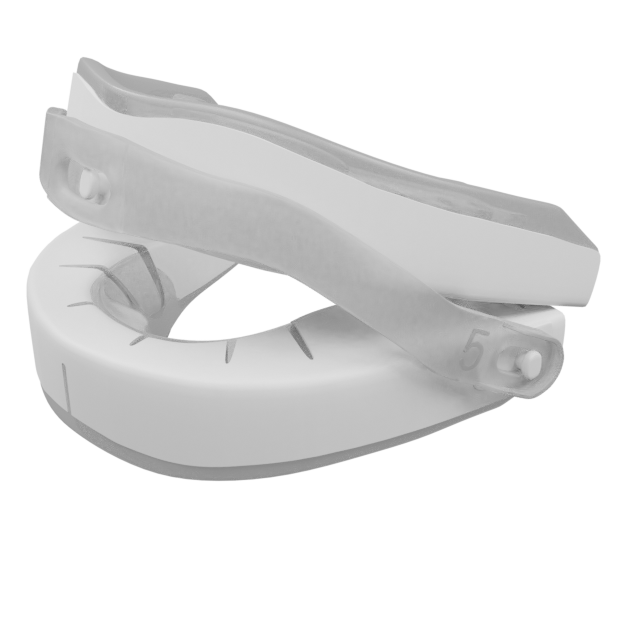
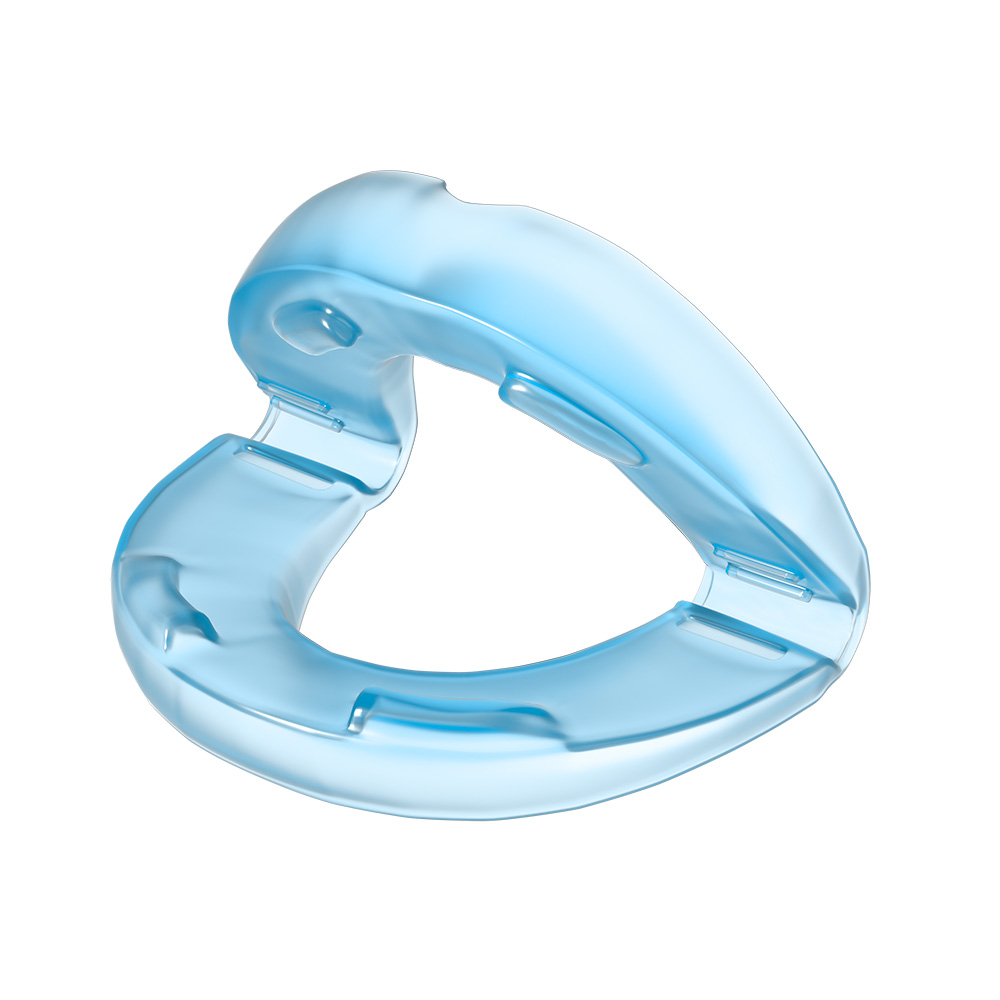
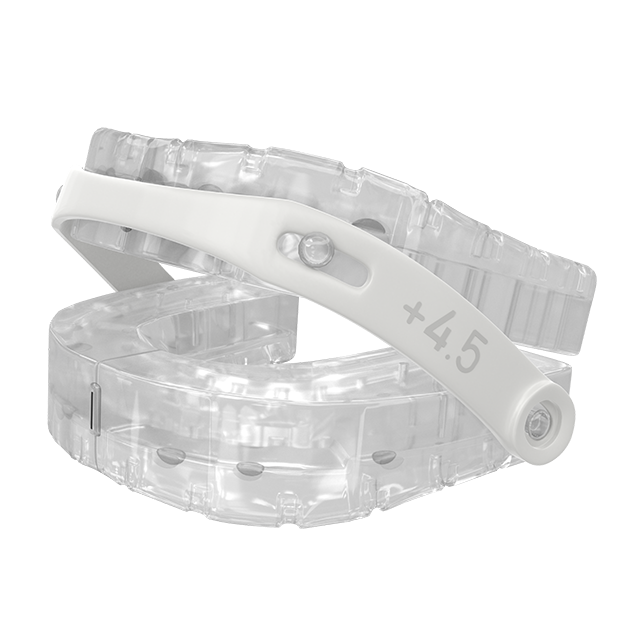
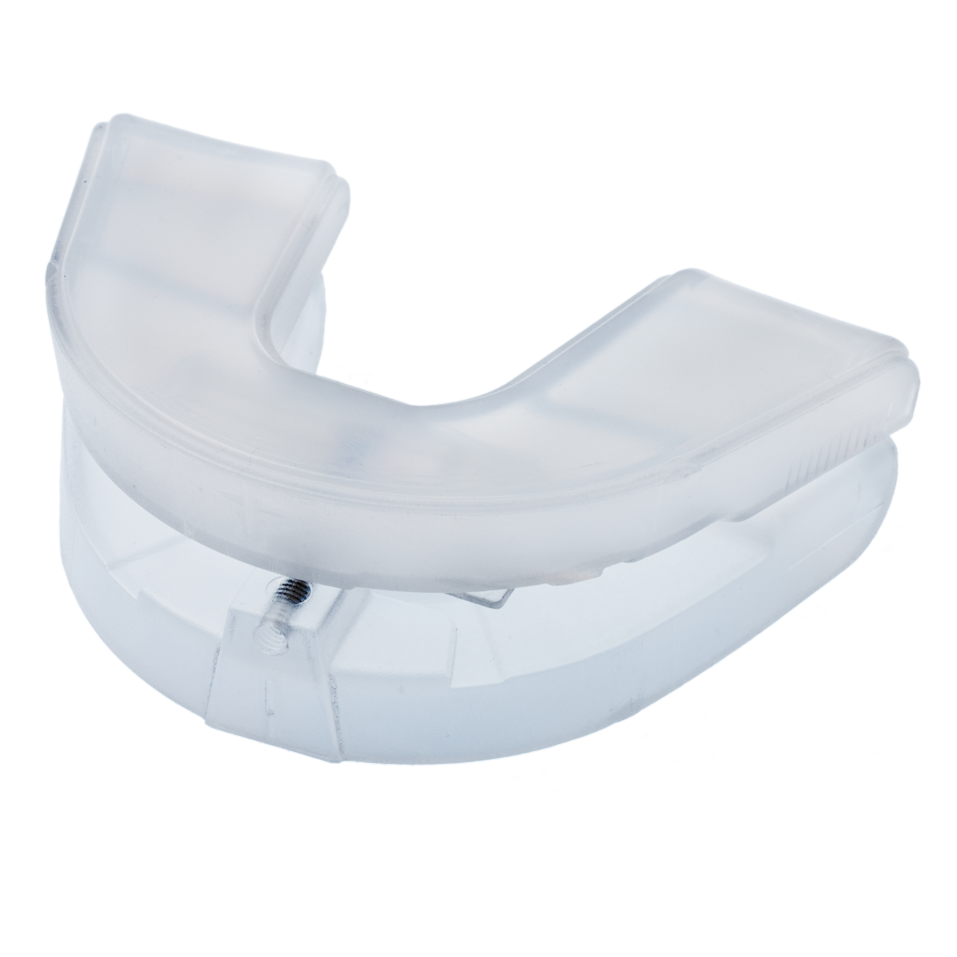
In the video: Presentation of the most popular snoring mouth guards
1. The top 3 snoring mouth guards of 2025
In a comparative video analysis, we have tested three popular snoring mouth guards for you: the somnipax guard, the SomnoGuard AP 2, and the SomnoFit
2. Comparison of entry-level mouthguards 2025
In a further comparison, we have tested two entry-level mouthguards for you: namely SomnoGuard 3, and ZQuiet
Comprehensive Guide 2025: What you should know about snoring mouth guards
We have advised thousands of customers on snoring mouth guards over the course of more than 10 years. Based on this extensive practical experience, we have compiled everything you really need to know about snoring mouth guards.
Our quick overview in the video:
What our top 3 selection criteria for snoring mouth guards are
1. Wearing comfort: Why this is so important
What use is an snoring mouth guard if it is so uncomfortable that it isn’t worn? That is why wearing comfort is the most important selection criterion. To understand this, you need to know one important distinction: the difference between one-piece and two-piece snoring mouth guards.
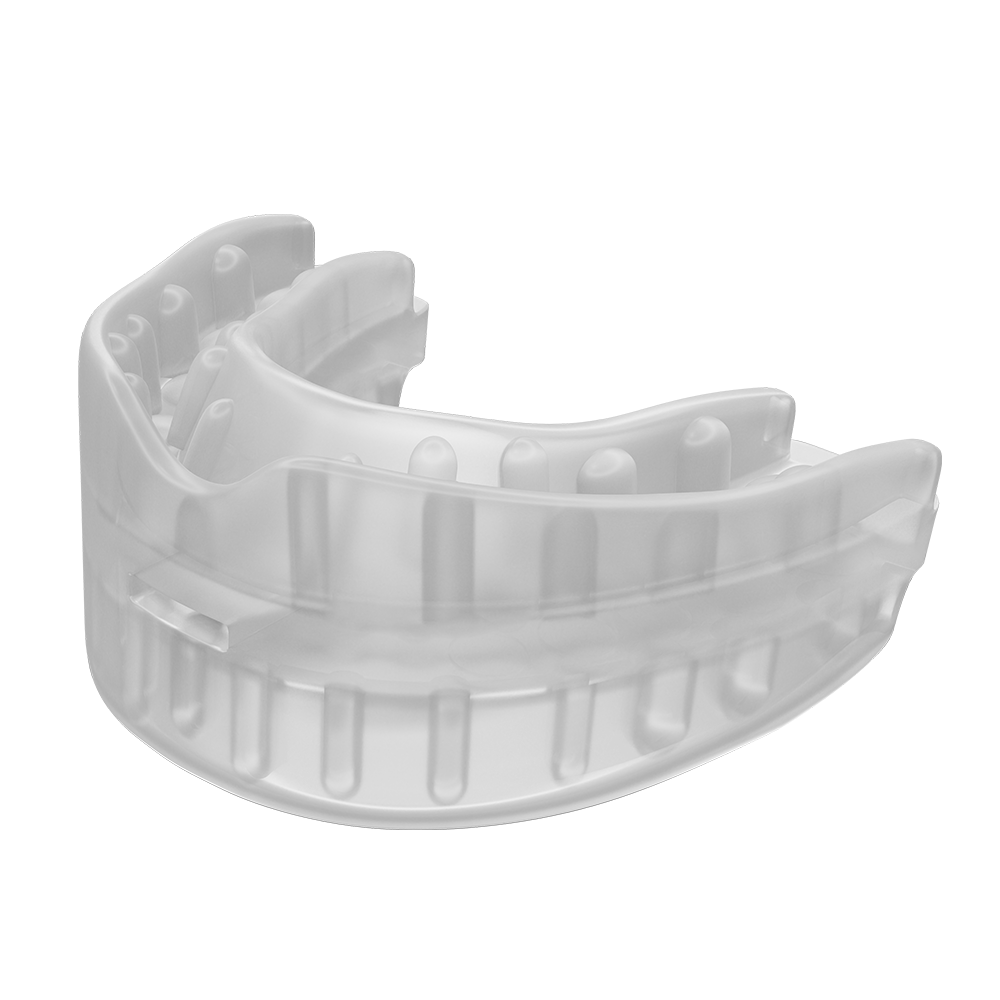
One-piece snoring mouth guards consist of a single block, usually a single casting. They are therefore very cheap to produce. BUT: They fix the lower jaw in place and prevent lateral movement of the temporomandibular joint (jaw joint). And this can often cause jaw joint pain.


This is different with two-piece snoring mouth guards. They consist of a separate part for the upper and lower jaw respectively and allow for lateral movement of the jaw joint.


Two further points are also important for wearing comfort: namely, how much material is used and how the pressure is distributed. As a general rule: the less material used, the higher the wearing comfort generally is. Older mouth guard models use more material, whereas newer models regularly have significantly less material.
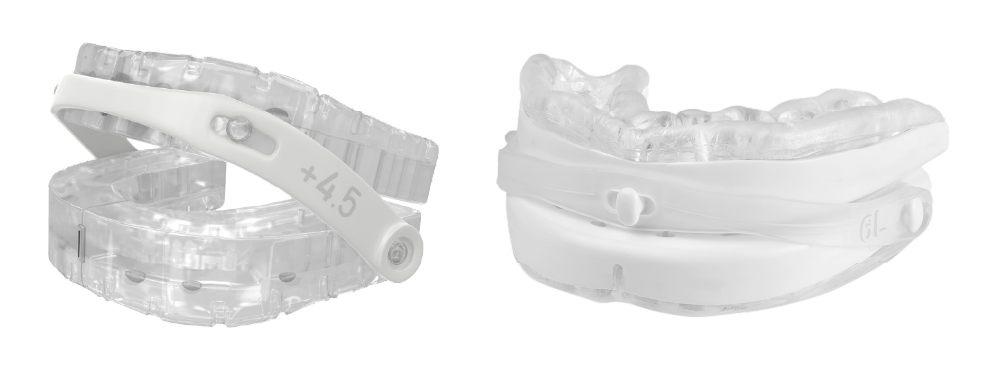
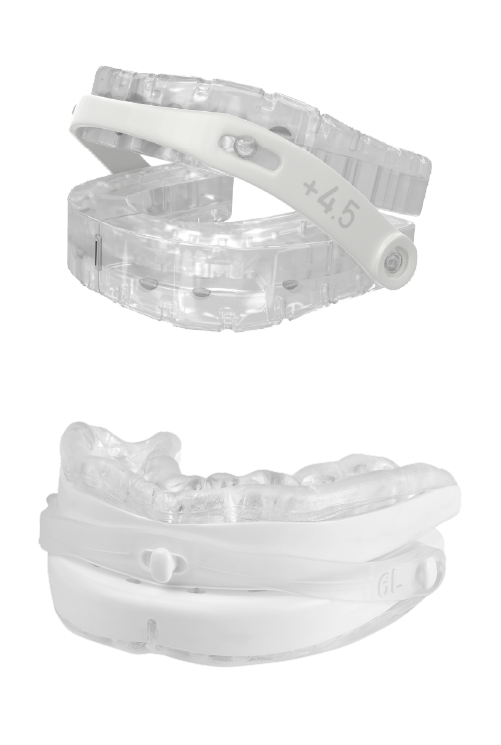
And regarding pressure distribution, there are also significant leaps between generations of manufacturers: for example, the internal structure of this new model ensures significantly better pressure distribution than in older models.
2. Size: Why you should use our cardboard trick
The same applies here: what use is the snoring mouth guard if it doesn’t fit your jaw? Mass-produced snoring mouth guards usually come in a universal size. However, this varies depending on the manufacturer.
There is a very simple method to find out whether a particular snoring mouth guard actually fits your jaw: namely by biting into a piece of clean cardboard and then comparing the measurements of the imprint with the size specifications for the respective mouth guard.
This only takes a few minutes, as the video below shows:
With custom-made dental mouth guards, this problem does not arise because they are made to measure for the specific user. However, they are also much more expensive.
3. Adjusting the advancement: what you need to know
The third selection criterion is the advancement setting. This is important for the effectiveness of the snoring mouth guard. The rule is: the greater the advancement, the more effective the mouth guard, but also the higher the risk that the mouth guard will be uncomfortable.
And when it comes to the advancement setting, there is also a very clear difference between one-piece and two-piece snoring mouth guards: with the one-piece mouth guard, the advancement is only set during the fitting process, i.e. not subsequently, after the fitting. In practice, this means that these mouth guards can only be adjusted very roughly and inaccurately. However, the user generally needs a precise adjustment of their snoring mouth guard to achieve the right balance between comfort and effectiveness.


Two-piece snoring mouth guards, on the other hand, are fitted separately to the upper and lower jaw in individual steps. This makes it possible to adjust the advancement subsequently. This offers significantly more flexibility, as the setting of the mouth guard can be changed without re-fitting, and it is also generally more precise.
If you pay attention to these 3 criteria, you will make a good decision when choosing an snoring mouth guard.
Simple to fit, wear for longer: how the snoring mouth guard becomes comfortable
Most snoring mouth guards can be heated in a water bath and then fitted to the teeth (the so-called ‘Boil & Bite’ method). This is simple to do and can generally be repeated several times. The advantage: significantly greater wearing comfort.


Some entry-level snoring mouth guards, such as ZQuiet, forgo this adjustability in favour of faster and even simpler use.
Snoring mouth guards don’t help with snoring? Top scientists say: False!
In 2020, the prestigious “IQWiG” foundation, funded by German statutory health insurance funds, confirmed regarding snoring mouth guards (technically known as “mandibular advancement devices”): “Mandibular advancement devices help against daytime sleepiness,” i.e., against the main symptom of obstructive sleep apnoea. The IQWiG views treatment with a mandibular advancement device as an equally effective remedy for obstructive sleep apnoea as CPAP therapy. To reach this conclusion, the IQWiG evaluated 37 medical studies in a 340-page final report.
And if snoring mouth guards are already so effective against snoring with breathing pauses (= obstructive sleep apnoea), then they are certainly effective against the milder form of snoring without breathing pauses (= primary snoring). In 2021, a Belgian-Chilean group of scientists attested to exactly this in a complex analysis of 18 medical studies:
“Despite the limited information on the treatment of primary snoring with mandibular advancement devices, current evidence suggests that mandibular advancement devices should be considered as a possible first-line treatment for patients with primary snoring. Furthermore, there is evidence that the treatment of primary snoring can have social, medical, and economic benefits.”
Sources:
IQWiG Press Release from 12 May 2020, Obstructive sleep apnoea: Mandibular advancement device helps against daytime sleepiness;
De Meyer M., Vandervelken O. et al., Use of mandibular advancement devices for the treatment of primary snoring with or without obstructive sleep apnea (OSA): A systematic review, Sleep Medicine Reviews, Vol. 56, April 2021, 101407
When to consult your dentist first
When should you only use an snoring mouth guard after consulting your dentist? Well, it depends crucially on the condition of your teeth. There are two practical rules of thumb:
- There should be ten healthy teeth in both the upper and lower jaw (i.e. a total of at least twenty healthy teeth).
- They should be distributed as follows: Five healthy teeth on both the left and right sides of the upper jaw, and another five healthy teeth on the respective left and right sides of the lower jaw.


If these rules of thumb are not met, you should definitely speak to your dentist before using an snoring mouth guard. Incidentally, bridges, crowns, or implants do not prevent the use of snoring mouth guards, provided they are firmly anchored and in good condition.
Further contraindications for snoring mouth guards include:
- loose teeth, particularly in the incisor area (because the propulsion pressure is strongest there)
- jaw pain or temporomandibular joint (TMJ) disorders
- braces, night guards for teeth grinding, or aligners, as these appliances cannot be combined with one another
- chronic asthma or epilepsy, as this can lead to shortness of breath.
In these cases, too, you should consult your doctor before purchasing or using an snoring mouth guard.
In our guide, you can find out what costs to expect for an anti-snoring mouthpiece from the dentist.
What are the side effects and disadvantages of snoring mouth guards?
Snoring mouth guards can have side effects such as tooth sensitivity, excessive salivation, or a change in tooth alignment. However, most side effects are only temporary or can be easily remedied.
| Side effect of snoring mouth guards | What can be done about it? |
| Sensitive teeth in the morning | Press your jaws together 3-4 times after getting up; tooth sensitivity often disappears then. |
| Jaw joint feels tense | Return your bite to its “normal state” by: Applying gentle backward pressure on the lower jaw with an open hand. Pressing your jaws together 3-4 times after getting up. Briefly chewing gum on the right and left sides of your dental arch. |
| Pain at the base of the ear | This occurs frequently right at the beginning but usually subsides quickly. To counter this, it can also help to reduce the advancement [of the jaw] initially and then only increase it gradually. Additionally, the exercises that return the bite to its “normal state” can be helpful here (see the point “Jaw joint feels tense”). |
| Heavy salivation | Usually subsides after a few days of regular use. |
| Interlocking of upper and lower teeth | The exercises that return the bite to its “normal state” can be helpful here (see the point “Jaw joint feels tense”). |
How to clean snoring mouth guards properly
You can clean the snoring mouth guard with mild soap and lukewarm water. Alternatively, you can put a little mouthwash into a cup; the mouthguard is then cleaned in this solution using a toothbrush. Remove the mouthguard from the liquid after no more than one minute and rinse it with clear water. For ideal cleaning, you can use special cleaning tablets or gels.


Under no circumstances should toothpaste or normal denture cleaners be used for cleaning! The ingredients can damage the surface of the mouth guard.
What are the alternatives to snoring mouth guards?
For primary snoring, positional therapy devices are a good alternative to snoring mouth guards. However, they can only be used if the snoring or obstructive sleep apnoea is positional—that is, if it occurs twice as often when lying on your back as when lying on your side. In such cases, they are an effective remedy against snoring and obstructive sleep apnoea. However, the body of research regarding passive positional therapy devices, such as anti-snoring vests, is generally less robust than that for snoring mouth guards.


Source:
DGSM S3 Guideline, Partial Update S3 Guideline Sleep-Related Breathing Disorders in Adults, 2020, p. 14. https://www.dgsm.de/fileadmin/neuigkeiten/2020/S3_SBAS_Teil-Aktualisierung_2020.pdf
The evidence base is more robust for active positional therapy devices that train users to sleep in a lateral position. The German Sleep Society (DGSM) therefore views active positional therapy as a realistic long-term treatment method for obstructive sleep apnoea (Source: DGSM S3 Guideline, Partial Update S3 Guideline Sleep-Related Breathing Disorders in Adults, 2020, p. 15. https://www.dgsm.de/fileadmin/neuigkeiten/2020/S3_SBAS_Teil-Aktualisierung_2020.pdf
Nasal dilators are occasionally used as a supplement to mandibular advancement devices (MADs), particularly if the MAD blocks mouth breathing. However, nasal dilators are not an alternative to MADs, as they address a completely different cause of snoring: nasal snoring.
In our overview of Top Snoring Stoppers, you will find genuine customer favourites with top ratings at affordable prices.
Frequently Asked Questions about Snoring Mouth Guard
Snoring mouth guards consist of a single piece or two interconnected plastic components worn over the teeth during sleep. They push the lower jaw (mandible) and, consequently, the base of the tongue forward. This keeps the pharynx (throat area) clear of the base of the tongue.
Snoring mouth guards are an effective remedy for primary, position-dependent snoring and obstructive sleep apnoea. They reduce or prevent snoring and breathing pauses. In 2020, the independent Institute for Quality and Efficiency in Health Care (IQWiG) explicitly stated that these devices help combat the leading symptom of obstructive sleep apnoea: daytime sleepiness (Press release dated 12 May 2020). This scientific finding was based on an extremely comprehensive analysis of clinical studies on snoring mouth guards conducted over a period of roughly two years.
A clinical study demonstrated that the use of a mandibular advancement device reduced snoring noise in 84% of patients. And that is not all—these devices can also effectively combat pathological snoring, specifically snoring accompanied by breathing pauses. A large comparative study showed that mandibular advancement devices reduced the number of breathing pauses by more than half in around 75% of the cases examined.
A high-quality, ready-made snoring mouth guard costs between £27.00 and £125.00 euros. The prices for custom-made devices, which are manufactured by a dentist, range from approximately £700 to £1,200.
A snoring mouth guard from a dentist costs approximately £700 to £1,200. The price depends on many factors, including the materials used and the individual complexity of the treatment. If in doubt, it is advisable to obtain a comparative quote from another dentist.
A distinction is made between prefabricated snoring mouth guards (such as somnipax guard) and custom-made ones. Prefabricated devices (also called boil-and-bite mouthguards) are manufactured industrially, whereas custom-made devices are generally produced in a dental laboratory.
Choosing the right device depends heavily on your individual snoring pattern.
• If you snore predominantly while sleeping on your back, a classic snoring mouth guard like the SomnoFit or somnipax guard standard can be particularly effective.
• For mouth snoring – i.e. snoring with an open mouth – a single-piece device like the SomnoGuard 3 is recommended, as it additionally blocks mouth breathing.
• If you only snore occasionally or situationally (e.g. when you have a cold or after consuming alcohol), a simple model like ZQuiet can be a sensible choice for a quick trial.
For sensitive sleepers with high comfort requirements, individually adjustable, two-piece models are ideal.
Yes, some of the ready-made anti-snoring devices on offer can be purchased in a pharmacy. However, the largest selection of ready-made devices is available in online shops such as SomniShop. With us, you also have the option to purchase the somnipax guard device with an extended 30-day trial right, meaning you can return the device even if it has been used. You will then receive a refund of the purchase price minus the trial fee.
One must distinguish between primary, i.e., non-pathological snoring, and pathological snoring (with breathing pauses): Snoring mouth guards are a recognised and the most frequently used remedy for primary snoring. CPAP, on the other hand, is not used in this area.
For pathological snoring, i.e., obstructive sleep apnoea, CPAP is still considered the standard therapy. However, it is estimated that 30-50% of CPAP patients discontinue CPAP therapy within the first year because they cannot cope with the side effects. Snoring mouth guards are also a recognised and effective remedy for obstructive sleep apnoea. In cases of obstructive sleep apnoea, they are used in particular when CPAP therapy cannot be carried out successfully.
In our opinion, the somnipax guard is currently the best snoring mouth guard among ready-made devices. It is our test winner because it is constructed with an exceptionally minimalist design, making it very comfortable to wear. At the same time, it is robust and features advancement that is adjustable in 8 steps.
Ready-made snoring mouth guards last approximately 6 to 9 months, though often longer with good care. The lifespan of dentist-made devices is often significantly longer, ranging from 3 to 5 years. However, these are also many times more expensive than ready-made snoring mouth guards.
Ready-made snoring mouth guards are heated in a water bath and then moulded to the teeth. The fitting process is kept so simple that even first-time users can usually do it without any problems.
Individually made snoring mouth guards are manufactured in a dental laboratory based on prior dental impressions and are then inserted—meaning fitted and adjusted—by the dentist.
Snoring mouth guards made by a dentist generally consist of two parts: one splint for the upper jaw and another for the lower jaw, which guide the lower jaw slightly forward. They feature adjustable elements on the sides to regulate this advancement. The mouth guard is custom-fitted to the teeth. In most cases, it leaves the palate free and allows the patient to sleep with their mouth closed. One-piece mouth guards from a dentist are rarely seen in practice.
A distinction must be made here between ready-made snoring mouth guards and custom-made ones. Ready-made snoring mouth guards can be delivered quickly (SomniShop delivery time is 1–2 working days within Germany) and fitted within a few minutes.
For custom-made snoring mouth guards, it can take several weeks after the initial dental appointment before the custom device is manufactured and ready to be fitted.
You are unsure about which MAD is suitable for you?
Then give us a call on +44 (131) 5070017 or send us an E-mail to service@somnishop.co.uk.
Anti-snoring mouthpieces – our comprehensive guide
Advice on what to look out for when purchasing an anti-snoring mouthpiece. Here we present different models and technical approaches

Discover the solution to your snoring with our free snoring test
Free of charge and only takes 3 minutes. Already over 95.000 participants.

Affordable snoring mouth guards for beginners
The 2 most popular entry-level models under £65 – determine which anti-snoring splint is the right fit for you.

All Mandibular Advancement Devices (MADs)
We have already sold tens of thousands of Mandibular advancement devices. Take advantage of our extensive experience with MADs

Managing Director Hannes Wakonig comes out of the Marketing and Finance branch and has previously worked in the field of medical technology. He is the co-founder and managing director of SomniShop (health.On Ventures GmbH) and AescuBrands.
 Welcome to SomniShop